
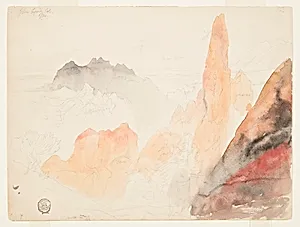
Glen Eyrie, Colorado
Classification
landscapes
Department
Smithsonian Collection
Museum
Smithsonian American Art Museum
Credit
Gift of Thomas Moran
Accession Number
1917-17-67
Rights
Public Domain
About this artwork
Research in Progress
Art Historical Context
Thomas Moran, born in Britain but a defining figure in American art (1837–1926), captures the majestic beauty of the American West in *Glen Eyrie, Colorado (1892). A master of the Hudson River School luminist traditions, Moran was renowned for his luminous landscapes that bathed rugged terrains in ethereal light, evoking a sense of divine wilderness. This work, classified as a landscape from the Smithsonian American Art Museum collection, reflects his lifelong passion for depicting the untamed American frontier. Painted during the Gilded Age, when railroads and tourism were opening the Rockies to eager explorers, *Glen Eyrie* likely portrays the dramatic canyons and cliffs near Colorado Springs—a site famed for its romantic, castle-like estate built by railroad magnate General William Jackson Palmer. Moran's sweeping vistas not only showcased artistic prowess but also fueled national pride and conservation efforts; his earlier Yellowstone sketches helped establish the first national park. Gifted by the artist himself to the Smithsonian, this piece underscores his commitment to preserving America's natural wonders through paint. Though details of the medium remain under research, Moran's technique—bold brushwork contrasting with soft atmospheric effects—invites viewers to feel the crisp mountain air and vast solitude, bridging 19th-century exploration with enduring environmental appreciation.