
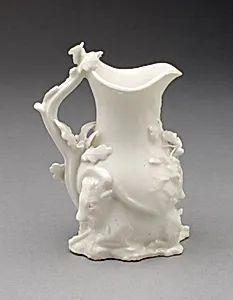
Goat and Bee Cream Jug
c. 1745
Medium
Porcelain
Dimensions
11.5 × 8.3 × 4.5 cm (4 1/2 × 3 1/4 × 1 3/4 in.)
Classification
porcelain
Department
Applied Arts of Europe
Museum
Art Institute of Chicago
Accession Number
5462
Rights
Public Domain
Art Historical Context
Created around 1745 the Chelsea Porcelain Factory, this delicate cream jug stands as one of the earliest surviving examples of English porcelain. Measuring just over four inches tall, the small vessel was likely modeled in the form of a recumbent goat with a bee perched nearby, reflecting the playful, naturalistic themes popular in mid-eighteenth-century decorative arts. At a time when true porcelain remained a costly import from East Asia, the Chelsea factory’s experiments with soft-paste porcelain helped establish a native British industry capable of producing refined tableware for the growing middle and upper classes. The jug’s modest size and charming subject matter highlight porcelain’s unique ability to capture fine detail while remaining practical for daily use. As part of the Applied Arts of Europe collection at the Art Institute of Chicago, it offers visitors a glimpse into the technical ambition and aesthetic tastes that shaped European ceramics during the early years of the medium’s development in Britain.