
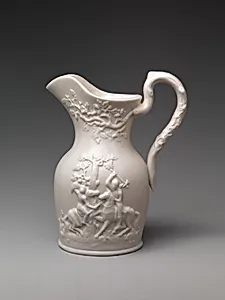
Pitcher
1847–48
Medium
Parian porcelain
Dimensions
6 7/8 x 5 1/8 x 4 1/4 in. (17.5 x 13 x 10.8 cm)
Classification
Pitcher
Culture
American
Department
The American Wing
Museum
Metropolitan Museum of Art, New York, NY
Credit
Gift of Dr. Charles W. Green, 1947
Accession Number
47.90.26
Rights
Public Domain
Tags
Art Historical Context
Step into the refined world of mid-19th-century American with this elegant *Pitcher* from Fenton's Works, crafted 1847 and 1848. Made of Parian porcelain—an unglazed, matte-white material prized for its marble-like translucency—this 6⅞ × 5⅛ × 4¼-inch vessel exemplifies the era's fascination with classical revival styles. Parian ware, developed in England but eagerly adopted by American makers, allowed artisans to produce affordable yet sophisticated decorative objects that mimicked expensive marble sculptures, bridging everyday utility with artistic aspiration. The pitcher's surface likely features molded reliefs of men and horses, evoking dynamic equestrian scenes that capture the spirit of American life during the antebellum period. Horses symbolized power, travel, and the expanding frontier, while such motifs reflected the growing confidence of U.S. manufacturers competing with European imports. Produced at Fenton's Works, a hub of innovative pottery, this piece highlights the technical prowess of slip-casting and fine detailing in porcelain, making luxury accessible to middle-class homes. Housed in The Metropolitan Museum of Art's American Wing and gifted by Dr. Charles W. Green in 1947, the *Pitcher* offers a tangible glimpse into 19th-century domestic elegance and industrial ambition. It's a testament to how everyday objects became canvases for cultural storytelling.