
Goblet
Unknown Artist
17th century
Medium
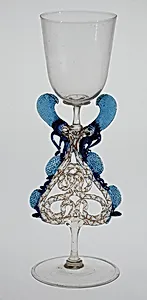
Colorless (yellowish), transparent turquoise blue, and opaque brick red, yellow, and white nonlead glass. Blown, trailed, pincered, "vetro a retorti".
Dimensions
H. 11 1/16 in. (28.1 cm)
Classification
Glass
Culture
Façon de Venise, probably south Lowlands or Germany
Department
Robert Lehman Collection
Museum
Metropolitan Museum of Art, New York, NY
Credit
Robert Lehman Collection, 1975
Accession Number
1975.1.1206
Rights
Public Domain
Tags
Art Historical Context
This elegant 17th-century gob, from the Robert Lehman Collection at the Metropolitan Museum of Art exemplifies *façon de Venise*—glassware crafted "in the Venetian fashion" outside Venice, likely in the south Lowlands or Germany. Standing at 11 1/16 inches tall its form showcases the period's fascination with luxurious, colorful tableware inspired by Renaissance Venice's renowned Murano glassworks. The unknown artist's use of nonlead glass—colorless yet yellowish, with transparent turquoise blue and opaque brick red, yellow, and white—evokes the soda-based formulas that allowed for vibrant, lightweight vessels prized by Europe's elite. Crafted through sophisticated techniques like blowing, trailing molten threads, pincering, and *vetro a retorti* (twisted cane glass), the goblet features intricate patterns, possibly including serpentine motifs that twist dynamically around its surface. This method created a mesmerizing interplay of colors and textures, mimicking the iridescent shimmer of true Venetian pieces while adapting to local traditions. Such goblets were status symbols at banquets, blending artistry with functionality. Though its exact provenance remains mysterious, this piece highlights the spread of Venetian glassmaking secrets across Europe, fueling innovation in the Lowlands and German workshops during the Baroque era. A testament to 17th-century craftsmanship, it invites visitors to appreciate the delicate alchemy of fire, color, and form.