
Goblet
Unknown Artist
ca. 1500–1525
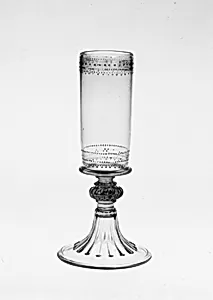
Medium
Colorless (slightly grayish tan) nonlead glass. Blown, pattern molded, enameled, gilt.
Dimensions
H. 3.2 cm; diam. of rim 8.2 cm
Classification
Glass
Culture
Italian (Venice)
Department
Robert Lehman Collection
Museum
Metropolitan Museum of Art, New York, NY
Credit
Robert Lehman Collection, 1975
Accession Number
1975.1.1198
Rights
Public Domain
Art Historical Context
This delicate goblet, crafted in Venice around 1500–1525, exemplifies the Renaissance mastery of Italian glassmaking. Hailing from the vibrant hub of Murano, where glass artisans honed secretive techniques, it stands just 3.2 cm tall with an impressively wide 8.2 cm rim—perfect for communal toasts or serving aromatic wines at elite banquets. Its slightly gray tan, colorless nonlead glass reflects the era's push for clarity and purity, rivaling rock crystal in luxury. The goblet's creation involved sophisticated methods: blown to shape the form, pattern-molded for textured surfaces, then enameled with vibrant colors and adorned with gold leaf (gilt) for opulent decoration. These techniques, guarded jealously by Venetian guilds, allowed for intricate designs that elevated everyday vessels into art objects, blending functionality with splendor. Housed in the Metropolitan Museum of Art's Robert Lehman Collection since 1975, this goblet offers a glimpse into Venice's global trade dominance, where such wares symbolized wealth and sophistication across Europe. Though by an unknown artist, it captures the anonymous genius of Murano's workshops, reminding us how glass—once as precious as gold—illuminated Renaissance tables.