
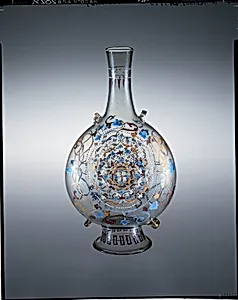
Pilgrim flask
ca. 1500–1525
Medium
Colorless (slightly tan) nonlead glass. Blown, enameled, gilt.
Dimensions
H. 12 3/8 in. (31.4cm)
Classification
Glass
Culture
Italian (Venice)
Department
Robert Lehman Collection
Museum
Metropolitan Museum of Art, New York, NY
Credit
Robert Lehman Collection, 1975
Accession Number
1975.1.1167
Rights
Public Domain
Art Historical Context
This exquisite *Pilgrim flask* from, Italy, dates to around 1500–1525, embodying the Renaissance mastery of glassmaking in the Republic of Venice. Standing at 12⅜ inches tall, it was crafted from colorless (slightly tan) non glass, blown into its elegant flask shape—perfect for pilgrims carrying holy water or relics on journeys to sacred sites. Venetian workshops, renowned for their innovative techniques, dominated Europe's luxury glass trade during this era, exporting these beauties across the continent. The flask's artistry shines in its enameled and gilt decoration, where powdered glass enamels were fused to the surface in vibrant colors, then accented with delicate gold leaf for a luminous effect. This labor-intensive process highlighted Venice's technological edge, using soda-lime glass (nonlead) that allowed for thin, clear blowing without the fragility of lead crystal. Such flasks were not just functional but status symbols, blending piety with opulence. Housed in the Robert Lehman Collection at The Metropolitan Museum of Art since 1975, this piece offers a window into Renaissance devotion and craftsmanship, reminding us how everyday objects became canvases for cultural splendor.
About the Artist
Italian
The designation "Italian" in art collections typically refers to an anonymous artist or a loose attribution to works from Italian schools, rather than a specific individual. With 173 known artworks in the museum's collection, this entry likely encompasses paintings by unidentified masters active across various periods, such as the Renaissance, Baroque, or later eras. Early life and personal detail...