
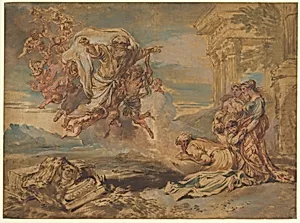
God the Father Appearing to Jacob
Medium
Brush with colored oil paint and touches of brown ink; paper partly saturated with oil
Dimensions
15 3/16 x 20 9/16 in. (38.6 x 52.3 cm)
Classification
Drawings
Department
Drawings and Prints
Museum
Metropolitan Museum of Art, New York, NY
Credit
Gift of Robert Lehman, 1965
Accession Number
65.176
Rights
Public Domain
Tags
Art Historical Context
In the evocative drawing *God the Father Appearing Jacob*, Giovanni Benedetto Cast—known as Il Grechettocaptures a pivotal biblical moment from Genesis, where God manifests to the sleeping patriarch Jacob, often linked to the vision of the ladder to heaven. Created around 1635–45 during the Italian Baroque era, this work reflects Castiglione's Genoese roots and his admiration for masters like Rembrandt and Van Dyck. The artist's dynamic compositions and dramatic lighting infuse the scene with spiritual intensity, portraying God the Father amid ethereal clouds, surrounded by male and female figures symbolizing divine attendants. Castiglione's innovative technique shines here: he applied colored oil paint with a brush directly onto paper partly saturated with oil, accented by touches of brown ink. This monotype-like method, rare for the 17th century, allowed for painterly effects akin to oil sketches, blending drawing and printmaking. The large sheet (15 3/16 x 20 9/16 in.) yields rich textures and luminous tones, showcasing his experimental genius that influenced later artists. A gift to the Metropolitan Museum of Art from Robert Lehman in 1965, this drawing highlights Baroque devotional art's emotional power, inviting visitors to ponder divine revelation through Castiglione's masterful fusion of medium and mysticism.
About the Artist
Giovanni Benedetto Castiglione (Il Grechetto) · 1609–1664
Giovanni Benedetto Castiglione, known as Il Grechetto, was baptized on March 23, 1609, in Genoa and died on May 5, 1664, in Mantua. Born into a large family, he collaborated closely with his brother Salvatore, an artist who shared his talents, and later taught his son Francesco, whose works were sometimes confused with his own. His parents placed him in the studio of Giovanni Battista Paggi, where...