
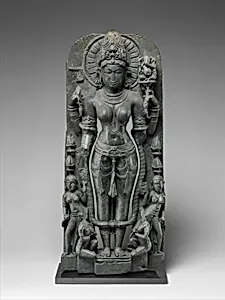
Goddess Gauri
Unknown Artist
10th century
Medium
Phyllite
Dimensions
H. 32 in. (81.3 cm); H. (with base) 32 3/4 in. (83.2 cm); W. 12 3/4 in. (32.4 cm); D. 5 5/8 in. (14.3 cm)
Classification
Sculpture
Culture & Period
India · Pala dynasty
Department
Asian Art
Museum
Metropolitan Museum of Art, New York, NY
Credit
Purchase, The Miriam and Ira D. Wallach Foundation Fund and Vijay K. Anand, M.D., Nanda Anand, Maya Anand, and Rohit Anand Gift, 2014
Accession Number
2014.519
Rights
Public Domain
Tags
Art Historical Context
Behold the serene *Goddess Gauri*, a masterful 10th-century sculpture from Pala dynasty, carved in lustrous phyllite—a fine-grained metamorphic stone prized for its smooth polish and durability. Standing at 32 inches tall (with base), this work hails from the Bengal region, where the Pala rulers (8th–12th centuries) fostered a age of Hindu and Buddhist art. Gauri, a benevolent form of the goddess Parvati, purity, fertility, and marital harmony, often depicted as Shiva's devoted consort in Hindu mythology. Pala sculptors excelled in capturing divine grace through intricate detailing and balanced proportions, evident in Gauri's poised stance and flowing garments. The use of phyllite allowed for a mirror-like finish that enhances the figure's ethereal glow, a technique that symbolized the sacred aura of deities. This piece reflects the dynasty's syncretic style, blending sensuous naturalism with spiritual iconography, making it a pinnacle of medieval Indian stone carving. Acquired in 2014 by The Metropolitan Museum of Art through generous gifts, *Goddess Gauri* invites visitors to ponder the enduring devotion to feminine divinity in South Asian culture, bridging ancient rituals with timeless beauty.