
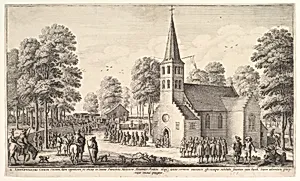
Going to Church
Medium
Etching; only state
Dimensions
Plate: 9 1/2 × 16 in. (24.2 × 40.7 cm) trimmed on the platemark
Classification
Prints
Department
Drawings and Prints
Museum
Metropolitan Museum of Art, New York, NY
Credit
Rogers Fund, 1920
Accession Number
20.81.2.176
Rights
Public Domain
Tags
Art Historical Context
**Going to Church**, a captivating 1651 etching, captures a serene rural procession toward a distant church steeple. Created after a design by Flemish artist Alexander Roelants masterfully etched by Bohemian printmaker Wenceslaus Hol, it also bears a dedication to Lamoral Claudius Franz, Count Thurn and Taxis reflecting noble patronage in the Baroque era. Hollar's precise etching technique—rendered in a single state—brings to life men on horseback, a horse-drawn carriage, lush trees, and architectural details with remarkable clarity and texture, on a generously sized plate of 9½ × 16 inches. This print exemplifies 17th-century topographical etching, a popular medium for documenting everyday life and landscapes across Europe. Hollar, renowned for his meticulous views of Antwerp, London, and beyond, infuses the scene with a sense of gentle motion and communal piety, evoking the cultural importance of Sunday churchgoing in Catholic Flanders amid post-Thirty Years' War recovery. Acquired by The Metropolitan Museum of Art through the Rogers Fund in 1920, this trimmed impression remains a gem in the Drawings and Prints collection, offering visitors a window into 17th-century rural devotion and Hollar's enduring legacy as one of etching's finest practitioners.
About the Artist
Alexander Roelants|Wenceslaus Hollar|Lamoral Claudius Franz, Count of Thurn and Taxis (German|Bohemian|Dutch) · 1621 |1607 |1650 –1676 |1677 |1650
German, 1621–1676|Bohemian, Prague 1607–1677 London|Dutch, active 1650