
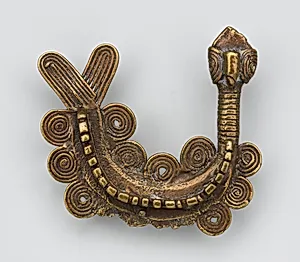
Gold Weight: Mudfish
Unknown Artist
18th–19th century
Medium
Brass
Dimensions
Height 1-7/8 in.
Classification
Metal-Implements
Culture
Akan peoples
Department
Arts of Africa, Oceania, and the Americas
Museum
Metropolitan Museum of Art, New York, NY
Credit
Gift of Ernst Anspach, 1994
Accession Number
1994.312.20
Rights
Public Domain
Tags
Art Historical Context
This exquisite brass *Gold Weight: Mudfish crafted by an unknown Akan artist in the 18th–19th century, exemplifies the of West African metalwork from present-day Ghana and Côte d'Ivoire. Standing just 1-7/8 inches tall, these diminutive sculptures were essential tools for the Akan peoples, who used them to measure gold dust—their primary currency in a thriving trade network. Produced via the sophisticated lost-wax casting technique each weight was a miniature masterpiece, balancing precision engineering with symbolic artistry. The mudfish form carries profound cultural weight, embodying resilience and adaptability. In Akan proverbs, the mudfish survives dry seasons by burrowing into mud, symbolizing perseverance amid hardship—a timeless lesson reflected in everyday commerce and philosophy. These weights doubled as teaching tools, sparking conversations about morality and wisdom during transactions. Housed in the Metropolitan Museum of Art's Department of Arts of Africa, Oceania, and the Americas (gift of Ernst Anspach, 1994), this piece invites us to appreciate the Akan's blend of utility and metaphor, where even a simple measuring implement becomes a portal to a rich worldview.