
S-Shaped Brooch
Unknown Artist
first half 6th century
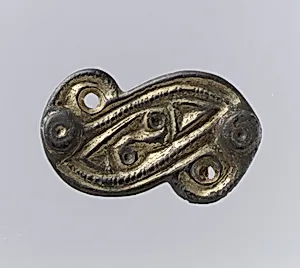
Medium
Silver-gilt
Dimensions
Overall: 1 x 9/16 x 1/4 in. (2.6 x 1.5 x 0.7 cm)
Classification
Metalwork-Silver
Culture
Frankish
Department
Medieval Art
Museum
Metropolitan Museum of Art, New York, NY
Credit
Gift of J. Pierpont Morgan, 1917
Accession Number
17.192.39
Rights
Public Domain
Art Historical Context
This delicate S-Shaped Brooch crafted by an unknown Frankish artisan in the first half of the 6th century, exemplifies the exquisite metalwork of early medieval Europe. Measuring just 1 x 9/16 x 1/4 inches (2.6 x 1.5 x 0.7 cm), its sinuous form—typical of Frankish jewelry—likely served as a fastener, blending practicality with ornamental flair. Housed in the Metropolitan Museum of Art's Art Department (gift of J. Pierpont, 1917), it reflects the Merovingian-era Frankish culture, which flourished in what is now France and Germany after the fall of Rome. Frankish brooches like this one were status symbols, worn by elites to secure garments and display wealth. The period marked a transition from Roman traditions to Germanic artistry, with such pieces often found in graves, hinting at their role in personal adornment and possibly funerary rites. Its silver-gilt construction—silver base overlaid with a thin gold layer via mercury gilding or foil—highlights advanced techniques that made luxury accessible, evoking the era's blend of barbarian vigor and refined craftsmanship. Today, this tiny treasure invites us to marvel at the skilled hands behind everyday elegance, bridging us to a world of migrating tribes and emerging kingdoms.