
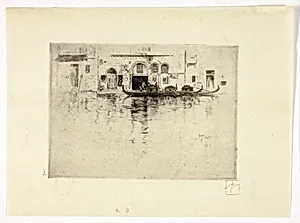
Gondolas and Venetian Palace
c. 1880
Medium
Etching and drypoint in black on ivory Japanese paper
Dimensions
Image/plate: 12.9 × 18 cm (5 1/8 × 7 1/8 in.); Sheet: 20 × 27.4 cm (7 7/8 × 10 13/16 in.)
Classification
etching
Department
Prints and Drawings
Museum
Art Institute of Chicago
Accession Number
87485
Rights
Public Domain
Art Historical Context
Robert Frederick Blum’s “Gondolas and Venetian Palace,” created around 1880, captures the timeless allure of Venice through the intimate lens of printmaking. The scene evokes the city’s famed canals and historic architecture, rendered with a delicate touch that invites viewers to imagine the gentle sway of gondolas and the quiet grandeur of its palaces. As an American artist working in the late nineteenth century, Blum participated in a broader fascination with Venice among Western artists, translating its romantic atmosphere into portable works on paper. The print’s medium—etching combined with drypoint, executed in black on ivory Japanese paper—highlights the technical sophistication of the period. Etching allows for fluid, expressive lines, while drypoint adds velvety textures and rich tonal contrasts, perfectly suited to suggesting water reflections and weathered stone. Japanese paper, favored for its soft surface and subtle warmth, enhances these effects and reflects the era’s growing appreciation for East Asian materials in Western printmaking. Housed in the Art Institute of Chicago’s Prints and Drawings collection, this modest yet evocative work (roughly five by seven inches) demonstrates how small-scale etchings could convey both personal observation and cultural fascination, offering museum visitors a window into nineteenth-century artistic travel and the enduring charm of Venice.
About the Artist
Robert Frederick Blum · 1857–1903
American mural painter. Comment on works: painter