
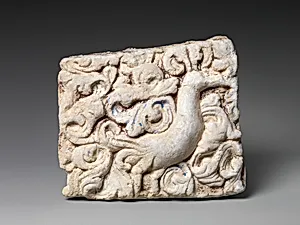
Goose (Hamsa) with Floral Tail
Unknown Artist
6th–7th century
Medium
Stucco with color
Dimensions
6 1/2 x 7 1/2 in. (16.5 x 19.1 cm)
Classification
Sculpture
Culture & Period
China (Xinjiang Autonomous Region) · Khotan Kingdom
Department
Asian Art
Museum
Metropolitan Museum of Art, New York, NY
Credit
Rogers Fund, 1930
Accession Number
30.32.8
Rights
Public Domain
Tags
Art Historical Context
This delightful stucco sculpture, titled *Goose (Hamsa) with Floral Tail*,ails from the Khotan Kingdom in China's Xinjiang Autonomous Region during the 6th–7th century. Measuring just 6½ x 7½ inches, it captures a graceful goose—known as the hams in ancient traditions—with an elaborate floral tail, rendered in vibrant colors on a molded stucco base. Stucco, a plaster-like medium, was widely used in Central Asian architecture for its versatility, allowing artists to sculpt intricate details and apply pigments for lifelike effects. Originating from Khotan, a thriving Silk Road oasis state, this piece reflects the cultural crossroads of Indian, Persian, and Chinese influences. The hamsa, a sacred bird symbolizing purity, transcendence, and the soul's journey in Buddhist lore, often adorned temples and shrines. Its floral embellishments evoke the lush motifs of the era, blending naturalism with symbolic ornamentation, likely as a decorative element from a Buddhist structure. As a rare survivor from this period, preserved through the Rogers Fund at The Metropolitan Museum of Art, it offers a glimpse into Khotan's artistic legacy—vibrant, syncretic, and exquisitely crafted for spiritual inspiration.