
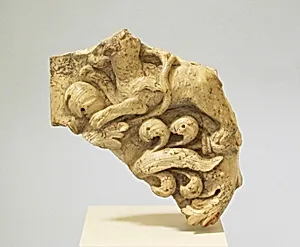
Marble relief fragment
Unknown Artist
1st–2nd century CE
Medium
Marble, Palombino
Dimensions
Overall: 3 15/16 x 5 1/2 in. (10 x 14 cm)
Classification
Stone Sculpture
Culture & Period
Roman · Imperial
Department
Greek and Roman Art
Museum
Metropolitan Museum of Art, New York, NY
Credit
Rogers Fund, 1917
Accession Number
17.230.118
Rights
Public Domain
Tags
Art Historical Context
This exquisite marble relief fragment, carved from fine-grained Palombino marble in the 1st–2nd CE during Rome's Imperial period, offers glimpse into the artistry of ancient Roman stone sculpture. Measuring a modest 3 15/16 x 5 1/2 inches (10 x 14 cm), it survives as a delicate piece, likely part of a larger decorative panel altar, or sarcophagus The tags "Cats" "Leaves" hint at charming subject: playful cats amid foliage, rendered in low relief with incised details that capture movement and texture. In the Imperial era, Roman sculptors mastered relief carving to adorn public monuments and private tombs, blending Greek realism with Roman narrative flair. Palombino marble, quarried near Rome, was prized for its smooth surface, allowing precise chisel work that brings the leaves' veins and the cats' fur to life. Cats, domesticated in Roman households (often imported from Egypt), symbolized domestic joy and vigilance, appearing in mosaics and reliefs as emblems of everyday life amid nature's abundance. Acquired through the Rogers Fund in 1917, this fragment now graces the Metropolitan Museum of Art's Greek and Roman Art department. It reminds us how Romans wove whimsy into their monumental art, inviting us to ponder the lively world of antiquity through these tiny, timeless survivors.