
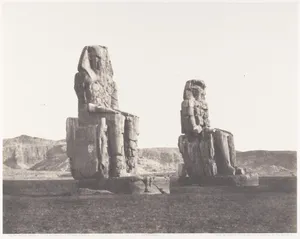
Gournah (Thèbes), Colosses (Celui de Droite, Dit de Memnon)
1851–52, printed 1853–54
Medium
Salted paper print from paper negative
Dimensions
23.9 x 30.5 cm. (9 7/16 x 12 in.)
Classification
Photographs
Department
Photographs
Museum
Metropolitan Museum of Art, New York, NY
Credit
Purchase, Lila Acheson Wallace Gift, 1976
Accession Number
1976.607.40
Rights
Public Domain
Tags
Art Historical Context
Step into ancient Egypt through Félix Teynard's *Gournah (Thèbes), Coloss (Celui de Dro, Dit de Memnon, a salted paper print from a paper created during his 1851–52 expedition printed around 1853–54. This intimate 23.9 x 30.5 cm photograph captures right-hand Colossi of Memnon—one of the towering quartzite statues of Pharaoh Amenhotep III—at the ruins of his vast mortuary temple in Thebes (modern Luxor). Known to the Greeks as "Memnon" for its mythical "singing" at dawn (likely wind through cracks, silenced after repairs), the colossus stands as a sentinel of pharaonic grandeur amid desert sands. Teynard, a pioneering French photographer working with Imprimerie Photographique de H. de Fonteny et Cie, produced some of the earliest precise documentations of Egyptian antiquities. His calotype process—using paper negatives for salted paper positives—yielded soft, textured tones that evoke the monuments' timeless mystery, contrasting sharp details of hieroglyphs and erosion with hazy skies. Published in his acclaimed album *Œuvre de photographie sur l’Égypte*, this image fueled 19th-century Egyptomania, bridging archaeology and art. Today, at the Metropolitan Museum of Art (purchase, Lila Acheson Wallace Gift, 1976), it reminds us how photography democratized the wonders of the Nile, preserving ruins for global audiences and highlighting the Colossi's enduring cultural icon status as symbols of imperial might and human ingenuity.
About the Artist
Félix Teynard|Imprimerie Photographique de H. de Fonteny et Cie · 1817–1892
**Félix Teynard (1817–1892)** was a pioneering French photographer whose work captured the ancient wonders of Egypt and Nubia with unprecedented precision and artistry. Born on January 14, 1817, in Saint-Flour, he trained as a civil engineer in Grenoble, a hub of Egyptology that likely sparked his fascination with ancient architecture. Little is documented about his early life or formal photograph...