
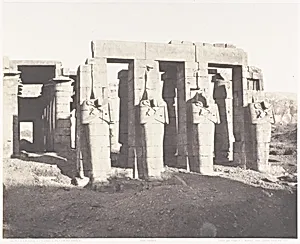
Gournah (Thèbes), Palais Dit le Memnonium
1851–52, printed 1853–54
Medium
Salted paper print from paper negative
Dimensions
24.5 x 30.1 cm. (9 5/8 x 11 7/8 in.)
Classification
Photographs
Department
Photographs
Museum
Metropolitan Museum of Art, New York, NY
Credit
Purchase, Lila Acheson Wallace Gift, 1976
Accession Number
1976.607.42
Rights
Public Domain
Tags
Art Historical Context
Step into the sun-baked grandeur of ancient Egypt Félix Teynard's *Gournah (Thèbes), Palais Dit lenonium* (1851–52, 1853–54). This salted paper print captures the majestic of the Memnoniumlikely the Ramesseum, the mortuary temple of Pharaoh Ramesses II in westernbes (modern Luxor). Towering columns rise amid weathered stones, evoking the splendor of New Kingdom Egypt (c. 1279–1213 BCE), where pharaohs built vast complexes to honor their legacies and eternal life. Teynard, a pioneering French photographer, documented these sites during his Nile expedition, producing one of the earliest comprehensive photographic surveys of Egypt. Printed by Imprimerie Photographique de H. de Fonteny et Cie using the calotype process—a paper negative yielding subtle tones and textures—this 24.5 x 30.1 cm image exemplifies mid-19th-century photography's technical leap. Unlike daguerreotypes, calotypes allowed multiple prints, making archaeological records widely shareable and fueling Europe’s Egyptomania. Today, at The Metropolitan Museum of Art (purchased with the Lila Acheson Wallace Gift, 1976), this photograph bridges antiquity and modernity, preserving fragile ruins for global audiences and highlighting photography’s role in scientific exploration. A testament to time’s passage, it invites us to ponder the pharaohs’ enduring monuments.
About the Artist
Félix Teynard|Imprimerie Photographique de H. de Fonteny et Cie · 1817–1892
**Félix Teynard (1817–1892)** was a pioneering French photographer whose work captured the ancient wonders of Egypt and Nubia with unprecedented precision and artistry. Born on January 14, 1817, in Saint-Flour, he trained as a civil engineer in Grenoble, a hub of Egyptology that likely sparked his fascination with ancient architecture. Little is documented about his early life or formal photograph...