
Gown (fourreau)
c. 1910
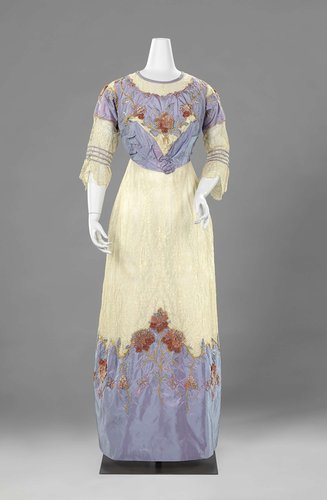
Medium
weaving
Dimensions
68; 160; 148
Rights
Public Domain
About this artwork
rok: wijdte 160 cm
Art Historical Context
Step into the elegant world of early 20th-century fashion this anonymous *Gown (fourreau)*, crafted around 1910 through intricate weaving techniques. Measuring 148 cm in length, with widths of 68 cm and a generous skirt breadth of 160 cm (as noted in its Dutch description "rok: wijdte 160 cm"), this piece exemplifies the textile artistry of its era. The medium of weaving highlights the labor-intensive process of creating fine fabrics, likely from silk or similar threads, which were hallmarks of high fashion garments designed for both daywear and evening allure. The fourreau style marked a revolutionary shift in women's silhouettes during the Belle Époque, moving away from the restrictive corsets of the Edwardian period toward a straighter, more streamlined form. Popularized in Paris around 1910, it symbolized emerging modernism and female emancipation, allowing greater freedom of movement. Though the creator remains unknown, such gowns were often produced by skilled ateliers, blending traditional weaving with innovative cuts that flattered the body's natural lines while incorporating dramatic skirt widths for sweeping elegance. Displayed in our virtual museum, this gown invites reflection on fashion's role as wearable art, preserving the tactile beauty of woven textiles and the cultural transitions of a pre-World War I world. A testament to anonymous craftsmanship, it whispers stories of glamour and change.
About the Artist
anonymous
In the vast tapestry of art history, "Anonymous" stands not as a singular individual but as a collective designation for countless unidentified creators whose works have endured across millennia. These artists, spanning prehistoric cave painters to medieval illuminators and folk craftsmen, produced the foundational layers of human visual culture. Prior to the Renaissance, when individual fame emer...