
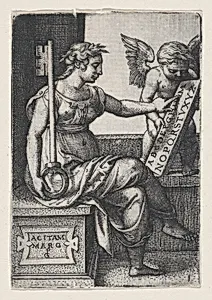
Grammatica, from The Liberal Arts
Medium
Engraving
Dimensions
Sheet: 2 15/16 × 1 15/16 in. (7.4 × 5 cm)
Classification
Prints
Department
Drawings and Prints
Museum
Metropolitan Museum of Art, New York, NY
Credit
Gift of Felix M. Warburg and his family, 1941
Accession Number
41.1.186
Rights
Public Domain
Tags
Art Historical Context
Georg Pencz, a leading figure among the Nuremberg Little Masters of the Northern Renaissance, crafted *Grammatica, from Liberal Arts* as a engraving that exemplifies the era's fascination with humanist education. Produced in the 16th century amid Germany's vibrant printmaking scene—influenced by Albrecht Dürer—Pencz's series personifies the seven liberal arts foundational disciplines like grammar, rhetoric, and astronomy that shaped Renaissance scholarship. This tiny sheet, measuring just under 3 by 2 inches, captures *Grammatica* (Grammar), the gateway to language and learning, often depicted as a poised woman holding keys symbolizing access to knowledge. Pencz's mastery shines in the engraving technique, where a burin incised fine lines into a copper plate for inked impressions, enabling widespread dissemination of intricate images at affordable prices. The detailed rendering of fabrics, attributes, and expressive features reflects the meticulous precision of German printmakers, blending Gothic intricacy with emerging Renaissance naturalism. As part of The Metropolitan Museum of Art's Drawings and Prints collection—gifted by the Warburg family in 1941—this work highlights how prints democratized classical learning during the Reformation, inspiring scholars and collectors alike. Visitors, imagine unlocking ancient texts through these symbolic keys—Pencz invites us to appreciate grammar not as dry rules, but as the elegant foundation of eloquence.
About the Artist
Georg Pencz · 1490–1550
Comment on works: Religious; History; Portraits