
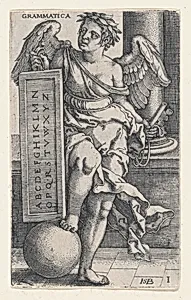
Grammatica, from "The Seven Liberal Arts"
Medium
Engraving
Dimensions
Sheet: 3 1/2 x 2 3/8 in. (8.9 x 6 cm)
Classification
Prints
Department
Drawings and Prints
Museum
Metropolitan Museum of Art, New York, NY
Credit
The Elisha Whittelsey Collection, The Elisha Whittelsey Fund, 1966
Accession Number
66.529.35
Rights
Public Domain
Art Historical Context
Sebald Beham, a leading figure among the German "Little Masters" of the Northern Renaissance, created *Grammatica, fromThe Seven Liberal Arts" a delicate engraving that personifies the foundational discipline of grammar. Part of a series celebrating the classical trivium (grammar, rhetoric, and dialectic) and quadrivium (arithmetic, geometry, music, and astronomy this print reflects the Renaissance revival of ancient learning, emphasizing education as a path to virtue and knowledge. Beham's tiny sheet—measuring just 3 1/2 x 2 3/8 inches—showcases his mastery of intricate line work, capturing fine details in clothing, attributes like books or scrolls, and expressive figures typical of his precise, jewel-like style. Engravings like this were revolutionary for their reproducibility, allowing humanist ideas to spread widely across Europe in the 16th century. Beham, active in Nuremberg, drew from Italian influences while rooting his work in German realism, making complex allegories accessible to scholars and collectors. Grammar, as the "gateway" to the liberal arts, symbolized structured language and moral instruction, resonating in an era of religious reform and printing innovation. Today, housed in the Metropolitan Museum of Art's Drawings and Prints department (The Elisha Whittelsey Collection, 1966), this gem invites us to marvel at how a minuscule plate could encode profound cultural values, bridging antiquity and the modern world.
About the Artist
Sebald Beham · 1500–1550
Sebald Beham (1500–1550), a pioneering German printmaker and painter born in Nuremberg, emerged as one of the most prolific artists of the Northern Renaissance. The elder brother of fellow artist Barthel Beham, he grew up in a milieu steeped in artistic tradition, though details of his early training remain sparsely documented. Recorded as a journeyman painter (Malergeselle) by 1521 and a master w...