
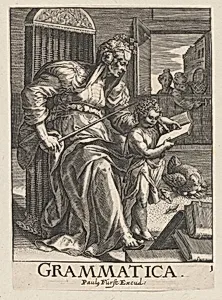
Grammatica, from The Seven Liberal Arts
ca. 1628–66
Medium
Engraving and etching
Dimensions
Sheet (Trimmed): 5 3/4 × 4 1/8 in. (14.6 × 10.5 cm)
Classification
Prints
Department
Drawings and Prints
Museum
Metropolitan Museum of Art, New York, NY
Credit
The Elisha Whittelsey Collection, The Elisha Whittelsey Fund, 1949
Accession Number
49.95.1498
Rights
Public Domain
Tags
Art Historical Context
"Grammatica, from Seven Liberal Arts" is captivating 17th-century print that personifies Grammar, the foundational art of language and literacy in the medieval trivium. Created around 1628–66, this small engraving and etching (5 3/4 × 4 1/8 in.) depicts a lively scene with men, women, and children in reading, accompanied by symbolic chickens—perhaps evoking attentiveness or domestic learning. As part of a series celebrating the Seven Liberal Arts, it reflects the Renaissance revival of classical education, where Grammar was seen as the gateway to wisdom. Collaboratively produced by Flemish engraver Johann Sadeler I, painter Maerten de Vos, and German printmaker Paulus Fürst, the work showcases masterful printmaking techniques. Engraving's precise lines and etching's fluid textures allowed for intricate details in a compact format, making these affordable prints popular for scholars' studies and homes. Housed in the Metropolitan Museum of Art's Drawings and Prints department (The Elisha Whittelsey Collection, 1949), it exemplifies Northern European graphic arts during a time when visual allegories democratized elite knowledge. This intimate artwork invites us to ponder the timeless value of reading and instruction, blending everyday figures with profound educational ideals in a single, richly detailed sheet.
About the Artist
Johann Sadeler I|Paulus Fürst|Maerten de Vos · 1550–1601
**Johann Sadeler I (also known as Jan or Johannes Sadeler), born in Brussels in 1550 and active until his death in Venice in 1600, stands as a pivotal figure in the Sadeler family, the most prolific dynasty of Flemish engravers and print publishers in Northern Europe during the late sixteenth and early seventeenth centuries.** As the eldest of three brothers—including Aegidius I and Raphael I—he ...