
松村呉春筆 葡萄図|Grapevine
after 1790
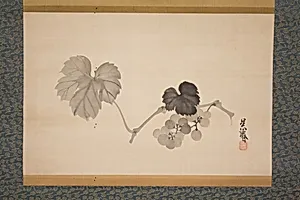
Medium
Hanging scroll; ink on silk
Dimensions
Image: 10 7/16 × 16 1/8 in. (26.5 × 40.9 cm) Overall with mounting: 43 1/16 × 20 5/16 in. (109.4 × 51.6 cm) Overall with knobs: 43 1/16 × 22 1/16 in. (109.4 × 56 cm)
Classification
Paintings
Culture & Period
Japan · Edo period (1615–1868)
Department
Asian Art
Museum
Metropolitan Museum of Art, New York, NY
Credit
The Howard Mansfield Collection, Purchase, Rogers Fund, 1936
Accession Number
36.100.20
Rights
Public Domain
Tags
Art Historical Context
Matsumura Goshun’s *Grapevine* is a delicate hanging scroll created after 1790 during Japan’s Edo period. Rendered in ink on silk, the compact composition captures clusters of grapes and twisting vines with fluid brushstrokes, emphasizing the natural elegance of the subject. As a hanging scroll, the work was designed for seasonal display in a tokonoma alcove, allowing viewers to appreciate its subtle tonal variations up close before it was rolled and stored. The painting reflects the refined tastes of late-eighteenth-century Japanese literati circles, where simple subjects drawn from nature often carried quiet symbolic resonance. Goshun’s restrained palette and sensitive handling of silk demonstrate the technical demands of ink painting on this luminous support, which absorbs pigment differently than paper and rewards precise control. Acquired by the Metropolitan Museum in 1936 as part of the Howard Mansfield Collection, *Grapevine* offers today’s visitors an intimate glimpse into the poetic naturalism prized during the Edo era.
About the Artist
Matsumura Goshun · 1752–1811
Born in Kyoto, 1752, the eldest son of a prominent family. He studied calligraphy, music, and painting from an early age. His painting studies were under Ōnishi Suigetsu.