
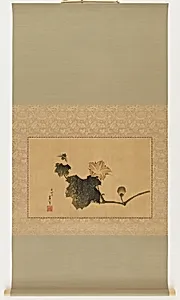
Pumpkin Vine and Horse Fly
ca. 1825-1833
Classification
Painting
Department
Smithsonian Collection
Museum
Smithsonian American Art Museum
Credit
Gift of Charles Lang Freer
Accession Number
F1898.111
Rights
Public Domain
Tags
About this artwork
Signed: Zen Hokusai Tameichi hitsu.
Art Historical Context
Katsushika Hokusai (1760–1849), one of Japan's most celebrated artists, created *Pumpkin Vine and Horse Fly* around 1825–1833 during the Edo period (1615–1868). This work bears his signature "Zen Hokusai Tameichi hitsu," reflecting one of his many pseudonyms as he constantly reinvented himself artistically. Hokusai is renowned for ukiyo-e—"pictures of the floating world"—a genre that captured fleeting moments of beauty in nature, daily life, and the ephemeral. At this stage in his career, he was producing innovative series like his *Manga* sketchbooks and iconic landscapes, showcasing his mastery of dynamic composition and observation. The painting depicts a lush pumpkin vine intertwined with a horse fly, highlighting Hokusai's fascination with the natural world. Ukiyo-e artists often used bold lines, vibrant colors, and asymmetrical balance to evoke harmony amid transience, drawing from woodblock printing techniques even in paintings. Though the exact medium is unknown, its classification as a painting aligns with Hokusai's versatile experimentation beyond prints, emphasizing intricate details like the vine's textured leaves and the fly's delicate wings. Acquired as a gift from collector Charles Lang Freer, who amassed exceptional Japanese art, this piece resides in the Smithsonian American Art Museum. It exemplifies Edo-era cultural vibrancy, where nature symbolized life's cycles, inviting viewers to appreciate the profound in the ordinary—just as Hokusai did throughout his 70-year career.