
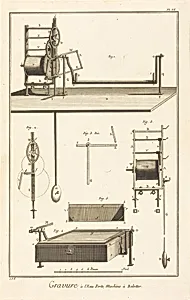
Gravure à l'Eau Forte, Machine à Balotter: pl. VI
Medium
engraving on laid paper
Dimensions
plate: 35.3 x 22.3 cm (13 7/8 x 8 3/4 in.) sheet: 40.2 x 26.3 cm (15 13/16 x 10 3/8 in.)
Classification
Department
CG-E
Museum
National Gallery of Art, Washington, D.C.
Credit
Ailsa Mellon Bruce Fund
Accession Number
1996.20.7
Rights
Public Domain
Art Historical Context
This exquisite 18th-century French, titled *Gravure à l'Eau Forte, Machine à Bal: pl. VI* (Etching, Balloting Machine plate VI), captures a fascinating slice of Enlightenment ingenuity. Created after the designs of engraver Robert Benard between 1771 and 1779, it depicts an intricate mechanical balloting device—likely an early voting machine used for anonymous elections. Such illustrations were common in technical treatises and encyclopedias of the era, reflecting France's booming interest in science, mechanics, and rational governance amid the pre-Revolutionary fervor. The artwork's medium, an etching on laid paper (plate 35.3 x 22.3 cm; sheet 40.2 x 26.3 cm), showcases the precision of *eau-forte* technique, where acid etches fine lines into a metal plate for detailed reproductions. Benard's style, rooted in the Rococo-to-Neoclassical transition, emphasizes clarity and functionality, making complex machinery accessible. As plate VI from a series, it highlights the collaborative world of 18th-century printmaking, where artists like Benard visualized innovations for scholars and the public. Housed in the National Gallery of Art's CG-E department through the Ailsa Mellon Bruce Fund, this print reminds us how art bridged technology and democracy, foreshadowing modern voting systems. A delightful window into history's gears turning toward progress!