
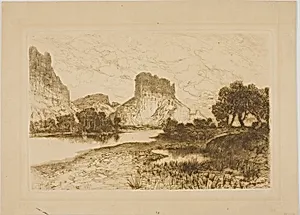
Green River, Wyoming Territory
1886
Medium
Etching on tan wove paper
Dimensions
Plate: 13.4 × 20.4 cm (5 5/16 × 8 1/16 in.); Sheet: 17.8 × 24.6 cm (7 1/16 × 9 11/16 in.)
Classification
etching
Department
Prints and Drawings
Museum
Art Institute of Chicago
Accession Number
149571
Rights
Public Domain
Art Historical Context
Thomas Moran, a leading figure in 19th-century American landscape art, created *Green River, Wyoming Territory* in 1886 as an etching that captures the dramatic cliffs and winding river of the American West. Known for his romantic depictions of frontier scenery, Moran helped shape public perceptions of the expanding nation during a period of westward exploration and settlement. This print distills the grandeur of Wyoming’s terrain into a compact yet evocative image. Executed as an etching on tan wove paper, the work demonstrates the medium’s ability to render fine lines and tonal contrasts that evoke the rugged textures of rock and water. Etching allowed Moran’s vision to reach wider audiences through reproducible prints, extending the influence of his larger paintings and illustrations beyond elite galleries. Now part of the Art Institute of Chicago’s Prints and Drawings collection, the etching reflects the cultural role of art in documenting and celebrating America’s natural landscapes at a pivotal historical moment. Its modest scale invites close viewing, revealing Moran’s skill in translating vast Western vistas into intimate, accessible form.
About the Artist
Thomas Moran · 1837–1926
Thomas Moran (1837–1926) was an American painter and printmaker of the Hudson River School whose dramatic paintings of the American West played a pivotal role in the creation of the national parks. Born in Bolton, Lancashire, England, he emigrated with his family to Philadelphia as a child. He was largely self-taught, though he apprenticed briefly with a wood engraver and studied the work of J.M.W...