
Greenshank
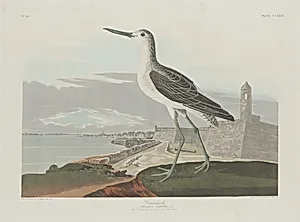
Medium
hand-colored engraving and aquatint on Whatman wove paper
Classification
Department
CG-W
Museum
National Gallery of Art, Washington, D.C.
Credit
Gift of Mrs. Walter B. James
Accession Number
1945.8.269
Rights
Public Domain
Art Historical Context
Behold the elegant *Greenshank*, a stunning hand-colored engraving and aquatint on Whatman wove paper created in 1835 by Robert Havell after John James Audubon. print is a gem from Audubon's legendary *Birds of America series (1827–1838), the most ambitious ornithological project of its time. Audubon, a pioneering naturalist and artist, depicted birds life-size in dynamic, naturalistic poses amid their habitats, revolutionizing scientific illustration by blending meticulous observation with artistic flair. Havell's masterful technique—engraving for precise lines and aquatint for subtle tonal gradations—brought Audubon's watercolor originals to vivid life. Hand-coloring by skilled artisans added lifelike feathers and habitats, making each print a collector's treasure on high-quality Whatman paper. Produced during the height of 19th-century natural history fervor, these works fueled public fascination with American wildlife and advanced printmaking as a medium for education and beauty. Today, housed in the National Gallery of Art's Department of Modern Prints and Drawings (gift of Mrs. Walter B. James), *Greenshank* captures the shorebird's slender grace, inviting visitors to appreciate how Audubon's vision bridged art, science, and conservation long before environmental awareness took flight.
About the Artist
Robert Havell after John James Audubon
Robert Havell Jr., born on November 25, 1793, in Reading, Berkshire, England, was the son of renowned engraver and publisher Robert Havell Sr. and Lydia Miller Phillips. Growing up in a family of artists that included notable engravers and etchers, he trained under his father, mastering aquatint techniques early on. Though briefly estranged from the family business, Havell reconciled with his fath...