
Greenwich Park
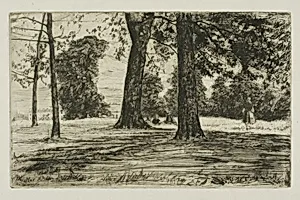
Medium
Etching and drypoint with foul biting in black ink on ivory laid paper
Dimensions
Plate: 12.8 × 20.5 cm (5 1/16 × 8 1/8 in.); Sheet: 19.8 × 31.6 cm (7 13/16 × 12 1/2 in.)
Classification
etching
Department
Prints and Drawings
Museum
Art Institute of Chicago
Accession Number
50813
Rights
Public Domain
Art Historical Context
James McNeill Whistler’s *Greenwich Park* (1859) captures the serene expanse of this historic London green space, a favored spot for leisurely views over the Thames. Created early in Whistler’s career, shortly after his arrival in England from Paris, the etching reflects his growing fascination with urban landscapes and atmospheric effects. As a pioneering figure in the Aesthetic movement, Whistler emphasized "art for art’s sake," prioritizing tonal harmony over narrative detail—a subtle foreshadowing of his later famous nocturnes. Printed in black ink on delicate ivory laid paper, the work showcases Whistler’s virtuoso etching and drypoint techniques. Etching involves acid biting into a metal plate to form precise lines, while drypoint adds velvety burrs from direct needle scratches, creating rich textures. The "foul biting"—unintended acid pits—lends an organic, spontaneous quality, enhancing the misty, evocative mood of the park’s trees and paths. At just 12.8 × 20.5 cm, its intimate scale invites close contemplation. Housed in the Art Institute of Chicago’s Prints and Drawings department, this piece exemplifies the 19th-century etching revival, where Whistler elevated printmaking to fine art. Visitors will appreciate its subtle play of light and shadow, a testament to Whistler’s lifelong pursuit of beauty in the everyday.
About the Artist
James McNeill Whistler · 1834–1903
James Abbott McNeill Whistler (1834-1903) was an American-born painter and printmaker who became a leading figure in the Aesthetic Movement and pioneer of Tonalism and Japonisme. He revolutionized art by championing "art for art's sake" and treating paintings as visual equivalents of musical compositions, titling works as "arrangements," "harmonies," and "nocturnes" to emphasize formal qualities o...