
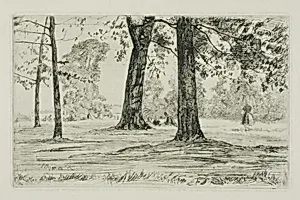
Greenwich Park
Medium
Etching with foul biting in black ink on cream laid paper
Dimensions
Plate: 12.8 × 20.5 cm (5 1/16 × 8 1/8 in.); Sheet: 26.6 × 36.4 cm (10 1/2 × 14 3/8 in.)
Classification
etching
Department
Prints and Drawings
Museum
Art Institute of Chicago
Accession Number
73416
Rights
Public Domain
Art Historical Context
James McNeill Whistler’s *Greenwich Park* (1859) captures the serene expanse of this historic London green space overlooking the Thames, rendered in a delicate etching that showcases the artist’s early mastery of printmaking. At just 26, the American-born Whistler, based in Paris and London, was influenced by French Realism and Japanese aesthetics, producing a series of Thames etchings known as the “Thames Set.” This work reflects his shift toward subtle tonal harmonies over dramatic detail, foreshadowing his later “Nocturnes” and emphasis on art for art’s sake. The medium—etching with foul biting in black ink on cream laid paper—highlights Whistler’s innovative technique. Etching involves drawing lines into a wax-coated copper plate, which acid etches to create incised lines for inking and printing. Foul biting, an accidental pitting from uneven acid exposure, adds a textured, atmospheric graininess that evokes misty English skies and lush parkland, transforming a flaw into artistic virtue. Measuring a modest plate size of 12.8 × 20.5 cm, it invites intimate viewing. Housed in the Art Institute of Chicago’s Prints and Drawings Department, *Greenwich Park* exemplifies 19th-century etching’s role in democratizing art through affordable multiples, while Whistler’s precision elevated it to fine art status. Visitors will appreciate its quiet poetry, bridging urban escape and industrial-age London.
About the Artist
James McNeill Whistler · 1834–1903
James Abbott McNeill Whistler (1834-1903) was an American-born painter and printmaker who became a leading figure in the Aesthetic Movement and pioneer of Tonalism and Japonisme. He revolutionized art by championing "art for art's sake" and treating paintings as visual equivalents of musical compositions, titling works as "arrangements," "harmonies," and "nocturnes" to emphasize formal qualities o...