
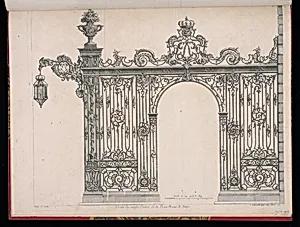
Grilles des angles d'entrée de la PLACE ROYALE DE NANCY
Medium
Bound print
Classification
Bound print
Department
Smithsonian Collection
Museum
Smithsonian American Art Museum
Credit
Purchased for the Museum by the Advisory Council
Accession Number
1921-6-218-8
Rights
Public Domain
About this artwork
Research in Progress
Art Historical Context
Jean Lamour (1698–1771), a master French ironsmith, created this bound print in 1767, depicting the ornate *Grilles des angles d'entrée la PLACE ROYALE DE NANCY*—the elegant entrance grilles at the corners of Nancy's grand Place Royale (now part of the UNESCO-listed Place Stanislas ensemble). Lamour's designs exemplify the opulent Rococo style of 18th-century France, blending intricate wrought ironwork with classical symmetry. These grilles, with their swirling motifs of foliage, shells, and mythical figures, served both as functional barriers and sculptural masterpieces, enhancing the ceremonial entrances to one of Europe's most harmonious urban squares. Commissioned during the reign of Stanislas Leszczyński, Duke of Lorraine, the Place Royale was a symbol of Enlightenment-era urban planning and absolutist grandeur. Lamour's ironwork, forged in collaboration with architects like Emmanuel Héré, transformed everyday elements into artistic triumphs, showcasing technical virtuosity in forging, chasing, and gilding. This print captures that legacy in two dimensions, likely from an architectural pattern book, preserving the designs for study and admiration. Acquired by the Smithsonian American Art Museum through its Advisory Council, this bound print bridges European decorative arts with American collections, inviting visitors to appreciate how Lamour's craftsmanship influenced global design traditions. Research continues to uncover more about its production, but it remains a window into 18th-century French elegance.