
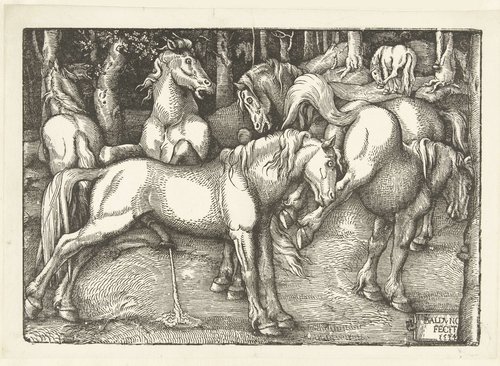
Groep van zes vechtende paarden
Medium
paper
Dimensions
330; 225
Rights
Public Domain
About this artwork
height 225 mm x width 330 mm
Art Historical Context
**Groep van zes vechtende paarden (Group of Six Fighting Horses)** Hans Baldung Grien, 1534 Drawing on paper, 225 × 330 mm Step into the dynamic world of Northern Renaissance art with Hans Baldung Grien's *Groep van zes vechtende paarden*, a spirited 1534 drawing on paper measuring a compact 225 × 330 mm. Created by the German artist— a talented pupil of Albrecht Dürer— this work captures six rearing horses locked in fierce combat, their muscles taut and manes flying in a whirlwind of motion. Baldung, renowned for his expressive woodcuts and paintings infused with drama and emotion, here showcases his mastery of the human (and equine!) form through intricate line work, likely employing pen and ink or chalk on paper, a medium prized for its immediacy and portability during the Renaissance. This piece reflects the era's fascination with anatomical precision and naturalism, influenced by Dürer's legacy, while Baldung's distinctive style adds a sense of wild energy and psychological intensity. Horses in 16th-century art often symbolized raw power, warfare, or untamed nature, making this study both a technical marvel and a vivid evocation of chaos. As a preparatory drawing, it highlights the preparatory role of paper sketches in grander compositions, offering museum visitors a rare glimpse into an artist's creative process. Don't miss how the small scale amplifies the intensity—perfect for contemplating the artistry in every rearing hoof!
About the Artist
Hans Baldung Grien
Hans Baldung, known by the nickname Grien, was born around 1484 or 1485 in Schwäbisch Gmünd, in the Swabia region of what is now Germany. He came from a distinguished academic family — his father Johann Baldung was a university-educated jurist who served as legal adviser to the bishop of Strasbourg — making Hans a notable exception as the first male in his family not to attend university, and one ...