
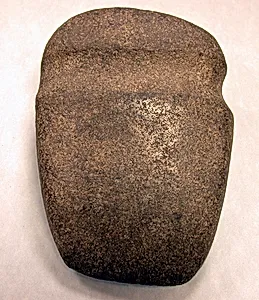
Grooved axe
Unknown Artist
ca. 6000–4000 BCE
Medium
Stone
Dimensions
W. 5 3/4 in. × D. 8 in. (14.6 × 20.3 cm)
Classification
Stone-Implements
Culture
Archaic
Department
Arts of Africa, Oceania, and the Americas
Museum
Metropolitan Museum of Art, New York, NY
Credit
Gift of Henry M. Davis, 1892
Accession Number
92.3a
Rights
Public Domain
Art Historical Context
This grooved axe, crafted from stone around 6000–4000 BCE, hails from the Archaic culture, an early prehistoric period in the Americas. Measuring 5¾ inches wide by 8 inches deep (14.6 × 20.3 cm), it the ingenuity of ancient peoples transitioning from nomadic hunter-gatherers to more settled communities. The distinctive groove along its body allowed it to be securely hafted to a wooden handle, transforming a simple stone into a powerful tool for woodworking or clearing land. As a stone implement, this axe highlights remarkable technical skill in an era before metalworking. Archaic artisans ground and polished the stone to create a durable, balanced form, reflecting advancements in lithic technology that supported expanding populations and resource management. Far from mere utility, such objects reveal cultural priorities—practical innovation intertwined with aesthetic symmetry. Acquired as a gift from Henry M. Davis in 1892 and now housed in the Metropolitan Museum of Art's Department of Arts of Africa, Oceania, and the Americas, this axe offers a tangible link to humanity's deep past, inviting us to ponder the hands that shaped it millennia ago.