
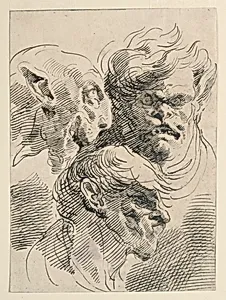
Grotesque Heads
Classification
figures
Department
Smithsonian Collection
Museum
Smithsonian American Art Museum
Credit
Gift of Hugh Cassel
Accession Number
1958-143-10
Rights
Public Domain
About this artwork
Research in Progress
Art Historical Context
### Grotesque Heads Pietro Antonio Novelli (1728–1804), a Venetian artist of the Rococo era, created *Grotesque Heads* between 1750 and 1775. Working in Italy during a time when decorative arts flourished amid the opulent tastes of the Venetian Republic, Novelli specialized in whimsical figures, capricci, and intricate etchings that captured the playful yet exaggerated spirit of 18th-century caricature. This artwork, classified as "figures" and now housed in the Smithsonian American Art Museum's collection (gift of Hugh Cassel), exemplifies his fascination with fantastical human forms, a nod to the Renaissance revival of ancient Roman grotesques—those bizarre, hybrid motifs unearthed in Nero's Domus Aurea and popularized by artists like Raphael. Grotesque heads, like those in Novelli's piece, were a beloved motif in European art, blending humor, horror, and ornamentation to adorn everything from frescoes to prints. Though the medium remains unidentified amid ongoing research, such works often employed drawing or etching techniques that allowed for fluid, expressive lines and dramatic contrasts, inviting viewers to ponder the boundaries between beauty and the bizarre. Novelli's versions likely showcase his skill in rendering distorted faces with lively energy, reflecting the era's delight in satire and the macabre. Today, *Grotesque Heads* offers a window into 18th-century Italy's artistic whimsy, bridging Rococo exuberance and emerging Neoclassicism. Its presence in an American collection highlights the global exchange of European masterpieces, enriching our understanding of cross-cultural influences in art history. (218 words)