
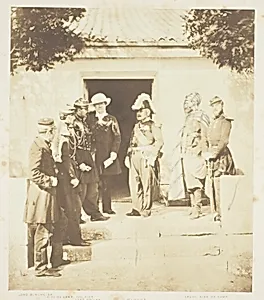
Group at Head Quarters
1855
Medium
Salted paper print, plate 1 from the album "Photographs Taken in the Crimea," 1856
Dimensions
Image/paper: 19.2 × 16.5 cm (7 9/16 × 6 1/2 in.); Mount: 58.9 × 42.5 cm (23 1/4 × 16 3/4 in.)
Classification
salted paper print
Department
Photography and Media
Museum
Art Institute of Chicago
Accession Number
146108
Rights
Public Domain
Art Historical Context
**Group at Head Quarters (1855) by Roger captures a pivotal moment from the Crimean War (1853–1856), one of the first conflicts documented through photography. Fenton, a pioneering British photographer, arrived in the Crimea in early 1855 with a custom photographic van—dubbed his "Photographic Van"—to record the British military campaign against Russia. This salted paper print, plate 1 from his 1856 album *ographs Taken in the Crimea depicts a group of officers and staff at headquarters, likely near Balaclava or Sevastopol, offering a rare glimpse into the war's logistical heart amid harsh conditions that claimed more lives from disease than battle. As an early salted paper print—a contact process using paper sensitized with sodium chloride, exposed under a glass negative, and fixed with chemicals—this work exemplifies mid-19th-century photography's technical innovations. Fenton's images, prized by Queen Victoria and exhibited widely, brought the war's realities home to the British public, influencing journalism and public opinion. Measuring just 19.2 × 16.5 cm on its mount, this intimate print from the Art Institute of Chicago's collection highlights Fenton's skill in composing poised portraits despite the chaos, marking photography's shift from studio novelty to historical witness. Today, it reminds us how Fenton's Crimea series laid groundwork for war photojournalism, blending artistry with stark documentation.
About the Artist
Roger Fenton · 1819–1819
Roger Fenton (1819–1869), born into a prosperous Lancashire merchant family as the son of banker and MP John Fenton, initially pursued a scholarly path, earning a first-class BA from the University of London in 1840 before studying law at University College London. He abandoned these pursuits for art, training as a painter under the history painter Charles Lucy in London by 1847—the two became clo...