
Guanyin
600 - 800
Medium
gild
Dimensions
7.8; 6.4; 4; 6.5; 16; 18.5
Rights
Public Domain
About this artwork
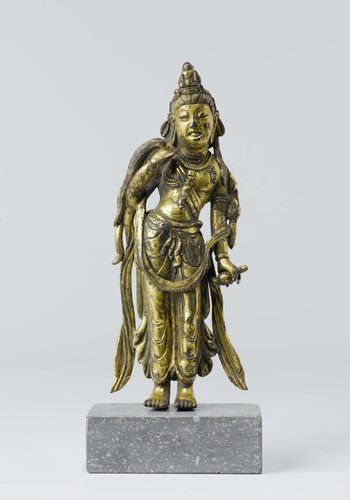
Avalokitesvara (Guanyin), staande in tribhanga; in de linkerhand een vliegenkwast en in de rechter een vaas; in de hoofdtooi een kleine Amitabha-boeddha. Op sokkel.
Art Historical Context
This exquisite gilt sculpture of Guanyin, dating from 600–800 CE, captures the bodhisattva of compassion—known as Avalokites in Sanskrit and Guanyin in Chinese—in graceful standing pose called *tribhanga*. This three-bend contrapposto, with the figure's hips and shoulders swaying in an elegant S-curve, conveys a of serene movement and approachability, hallmarks of Tang dynasty Buddhist art (618–907 CE). Crafted anonymously by skilled artisans, the small statue (16 cm high) was likely intended for personal devotion or a household altar, its intimate scale inviting quiet contemplation. In the left hand, Guanyin holds a fly whisk, symbolizing the dispelling of ignorance, while the right grasps a vase of pure water, representing mercy and healing. A diminutive Amitabha Buddha crowns the headdress, linking Guanyin to Pure Land Buddhism and the promise of enlightenment. The gilding technique—applying a thin layer of gold over a probable bronze core—enhances the figure's divine radiance, mimicking the aura of sacred light in Buddhist iconography and underscoring the era's metallurgical mastery. Perched on a simple pedestal, this artwork reflects Tang China's cosmopolitan flourishing, when Buddhism blended Indian influences with local elegance, making Guanyin a beloved protector for all beings. Visitors are drawn to its luminous presence, a testament to faith's enduring artistry.
About the Artist
anonymous
In the vast tapestry of art history, "Anonymous" stands not as a singular individual but as a collective designation for countless unidentified creators whose works have endured across millennia. These artists, spanning prehistoric cave painters to medieval illuminators and folk craftsmen, produced the foundational layers of human visual culture. Prior to the Renaissance, when individual fame emer...