
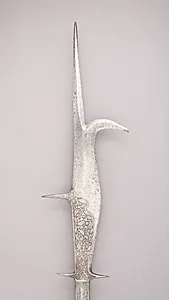
Guisarme
Unknown Artist
16th century
Medium
Steel, wood, textile, metallic thread
Dimensions
L. 96 1/4 in. (244.5 cm); L. of head 34 1/4 in. (87 cm); W. 10 in. (25.4 cm); Wt. 5 lbs. 7.3 oz. (2474.9 g)
Classification
Shafted Weapons
Culture
Italian
Department
Arms and Armor
Museum
Metropolitan Museum of Art, New York, NY
Credit
Gift of Mrs. Robert de Forest, 1914
Accession Number
14.145
Rights
Public Domain
Art Historical Context
Step into the riveting world of Renaissance warfare with this 16th-century Italian *Guisarme*, a masterful shafted weapon now housed in the Metropolitan Museum of Art's Arms and Armor Department. Measuring an imposing 96¼ inches in length—with a hefty head spanning 34¼ inches—this steel-tipped polearm, weighing just over 5 pounds, was designed for battlefield versatility. Its broad, hooked blade could slash, stab, or pull mounted knights from their horses, embodying the evolution of medieval weaponry into the Renaissance era. Crafted by an unknown Italian artisan, the guisarme highlights exceptional metallurgical skill, with a sharpened steel head forged for lethal precision and durability. The wooden shaft, reinforced with textile wrappings and metallic thread, ensured a secure grip during prolonged combat, blending functionality with subtle decorative flair. In 16th-century Italy, amid city-state rivalries and mercenary armies like the condottieri, such weapons were essential for infantry facing heavily armored foes. A generous gift from Mrs. Robert de Forest in 1914, this guisarme invites us to ponder the artistry in arms—where survival met superb craftsmanship. Though battle-worn, it stands as a testament to Italy's renowned armorers, bridging history's brutal clashes with timeless ingenuity.