
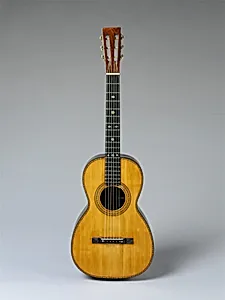
Guitar
ca. 1870
Medium
Spruce, rosewood, ebony
Dimensions
36 13/16 × 11 11/16 × 3 1/4 in. (93.5 × 29.7 × 8.3 cm)
Classification
Chordophone-Lute-plucked-fretted
Culture
American
Department
Musical Instruments
Museum
Metropolitan Museum of Art, New York, NY
Credit
Purchase, The Jonathan & Faye Kellerman Foundation Gift, 2010
Accession Number
2010.334
Rights
Public Domain
Art Historical Context
This elegant guitar, crafted around 1870 by Joseph Bini and John Howard Foote, represents a fine example of American luthiery during a period when the instrument was gaining popularity in the United States. from spruce for its resonant top, rosewood for the back and sides, and ebony for the fingerboard, the instrument exemplifies the thoughtful selection of tonewoods prized for their acoustic properties and visual appeal. Its classification as a chordophone-lute-plucked-fretted highlights its place within the broader family of stringed instruments that evolved from European traditions yet adapted to American tastes. Measuring just over 36 inches in length, the guitar’s compact form and refined materials reflect the craftsmanship of mid-19th-century makers who balanced functionality with subtle ornamentation. John Howard Foote, known as both a maker and dealer, contributed to a growing domestic market for quality guitars at a time when parlor music and home entertainment flourished across the country. Acquired by the Metropolitan Museum of Art in 2010, this piece offers visitors a tangible connection to the era’s musical culture, where such instruments served not only as tools for performance but also as symbols of refined domestic life.
About the Artist
Joseph Bini|John Howard Foote (American, born Italy|American) · 1810 | –1877 |
ca. 1810–1877|