
Gulli I
1914
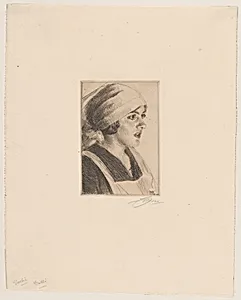
Medium
Etching; second state of two
Dimensions
Plate: 5 1/16 × 3 1/2 in. (12.9 × 8.9 cm) Sheet: 12 5/8 × 10 1/16 in. (32.1 × 25.6 cm)
Classification
Prints
Department
Drawings and Prints
Museum
Metropolitan Museum of Art, New York, NY
Credit
Harris Brisbane Dick Fund, 1917
Accession Number
17.3.675
Rights
Public Domain
Tags
Art Historical Context
Anders Zorn's *Gulli I* (1914) is a delicate etching that exemplifies the Swedish artist's mastery ofmaking during the early 20th century.owned for his luminous portraits and nudes, Zorn captured everyday with remarkable intimacy and realism, often drawing from his personal circle. This second state of two—a refined proof showing final tweaks by the artist—presents a poised woman, likely from Zorn's life, her features rendered with exquisite line work that conveys subtle emotion and texture. Etching allowed Zorn to achieve painterly effects on paper, using aquatint and drypoint to mimic the play of light on skin and fabric, a technique he perfected after studying Rembrandt. At just 5 1/16 × 3 1/2 inches on the plate, the work's small scale invites close viewing, highlighting his virtuosic control over ink and burr for velvety depths and sparkling highlights. Acquired by the Metropolitan Museum of Art in 1917 via the Harris Brisbane Dick Fund, it reflects the era's growing appreciation for graphic arts. Produced on the eve of World War I, *Gulli I* offers a quiet moment of elegance amid global upheaval, underscoring Zorn's enduring legacy in bridging Impressionist light effects with Nordic precision. A gem for print enthusiasts, it reveals the power of the humble etching to immortalize humanity.
About the Artist
Anders Zorn · 1860–1920
Anders Zorn (1860–1920), one of Sweden's most celebrated artists, was born on February 18 in Utmeland near Mora in Dalarna, and raised on his maternal grandparents' farm in the nearby hamlet of Yvraden. Displaying prodigious talent from a young age, he attended school in Mora Strand until age twelve, followed by secondary grammar school in Enköping, where he excelled in drawing people and horses. ...