
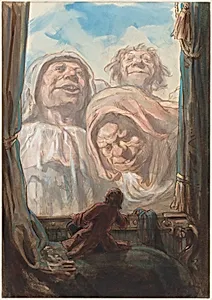
Gulliver Awed by Three Giant Beggars in the Land of Brobdingnag
1862
Medium
pen and brown ink with watercolor and gouache over graphite on wove paper, laid down
Dimensions
sheet: 23.2 x 16.4 cm (9 1/8 x 6 7/16 in.)
Classification
Drawing
Department
CG-E
Museum
National Gallery of Art, Washington, D.C.
Credit
Ailsa Mellon Bruce Fund
Accession Number
2009.26.1
Rights
Public Domain
Art Historical Context
In the whimsical yet satirical world of Jonathan Swift's *Gulliver's Travels*, land of Brobdingnag with giants, and Paul Gavarni's 1862 drawingGulliver Awed by Giant Beggars in Land of Brobding* captures this surreal moment with vivid flair. The French illustrator, renowned for his sharp social commentary in periodicals like *Le Charivari*, reimagines Gulliver as a tiny figure dwarfed by ragged colossal beggars, their immense forms looming in exaggerated scale. Created late in Gavarni's career (1804–1866), this work reflects the 19th-century fascination with literary illustration, blending humor with a touch of the grotesque. Executed in pen and brown ink with watercolor and gouache over graphite on wove paper (23.2 x 16.4 cm), the piece showcases Gavarni's masterful mixed-media technique. The fluid ink lines define dramatic contrasts, while subtle watercolor washes and opaque gouache heighten the beggars' textured, weathered skin and tattered clothes, evoking both awe and pity. Laid down for preservation, this intimate drawing highlights the tactile quality of works on paper, prized in 19th-century salons for their immediacy over grand oils. Acquired through the Ailsa Mellon Bruce Fund at the National Gallery of Art, it exemplifies how illustrators like Gavarni bridged literature and visual art, influencing later cartoonists. Visitors will delight in its nod to Swift's satire on human folly, reminding us that size truly matters in the eye of the beholder.
About the Artist
Paul Gavarni · 1804–1866
Paul Gavarni, born Sulpice Guillaume Chevalier on January 13, 1804, in Paris to a cooper father from Burgundy and mother Marie-Monique Thiémet—whose brother, painter Guillaume Thiémet, served as his godfather—began his career far from the art world. As a youth, he worked in a machine factory and studied mechanical drawing at the Conservatoire des Arts et Métiers in 1818, followed by evening classe...