
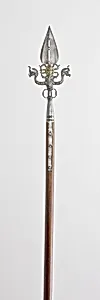
Gunner's Linstock (Matchholder) combined with Spear
1600/30
Medium
Steel, wood (oak), bronze, and iron
Dimensions
H.: 203.2 cm (80 in.); Blade with socket: H.: 36.2 cm (14 1/4 in.)
Classification
combination weapon
Department
Applied Arts of Europe
Museum
Art Institute of Chicago
Accession Number
106518
Rights
Public Domain
About this artwork
Pole arms (staff weapons) were used not only in warfare and hunting, but also in sporting combat and ceremonies. The term refers to a family of edged weapons attached to wooden staffs. With the exception of the lance, which remained the weapon of the mounted knight, all other staff weapons were wielded by men on foot by 1600. With the development of firearms and their introduction as infantry weapons, pole arms lost their importance on the field, and from the mid-16th century, they were reserved...
Art Historical Context
This striking combination weapon from 1600–1630 unites a gunner’s linstock with a spear, reflecting the practical ingenuity of early modern European warfare. Standing over 80 inches tall, it features an oak shaft fitted with steel, bronze, and iron components, including a 14-inch blade. A linstock was a forked staff used to hold a slow-burning match for igniting cannons, allowing artillerymen to fire their pieces from a safe distance. By adding a spearhead, the unknown craftsman created a dual-purpose tool that served both as a firing device and a close-combat weapon. In an era when artillery was transforming battlefields, gunners often found themselves exposed to enemy infantry. Combination weapons like this one addressed that vulnerability, blending the emerging technology of gunpowder with traditional polearms. The robust materials—durable oak for the shaft and metals for the working parts—highlight the skilled metalworking and woodworking of the Applied Arts of Europe, where function and form met the demands of 17th-century military life. Now in the Art Institute of Chicago, this piece offers a tangible glimpse into the resourcefulness of the period, when soldiers and artisans alike adapted to the rapid evolution of warfare.
About the Artist
Unknown
The artist designated as "Unknown" in our virtual museum's collection exemplifies a poignant chapter in art history: creators whose identities have faded into obscurity despite the enduring power of their work. With only one known artwork attributed to them in our holdings, this figure represents countless anonymous hands that shaped visual culture across centuries. Museums worldwide, including th...