
Gustav Heinrich Naeke
Medium
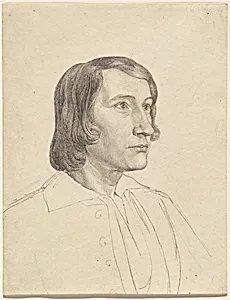
pen and black ink over graphite on wove paper
Dimensions
sheet: 15.5 x 12 cm (6 1/8 x 4 3/4 in.)
Classification
Drawing
Department
CG-E
Museum
National Gallery of Art, Washington, D.C.
Credit
Wolfgang Ratjen Collection, Patrons' Permanent Fund
Accession Number
2007.111.162
Rights
Public Domain
Art Historical Context
This delicate portrait drawing captures Gustav Heinrich Naeke, a fellow German artist and contemporary of Julius Schnorr von Carolsfeld, around 1820. Created during Schnorr’s formative years in Rome, where he joined the Nazarene Brotherhood, the work reflects the group’s emphasis on precise draftsmanship and a revival of early Renaissance ideals. Schnorr’s choice of pen and black ink over graphite allows for crisp, expressive lines that convey both likeness and character with remarkable economy. Measuring just 15.5 by 12 centimeters, the intimate scale invites close viewing, highlighting the artist’s technical skill in balancing graphite underdrawing with confident ink strokes. Such portraits often served as tokens of friendship within artistic circles, preserving personal connections amid the cultural exchanges of early nineteenth-century Europe. Now part of the National Gallery of Art’s Wolfgang Ratjen Collection, the drawing offers modern visitors a glimpse into the Nazarene movement’s commitment to sincerity, detail, and the enduring power of line.
About the Artist
Julius Schnorr von Carolsfeld · 1794–1872
German, Leipzig 1794–1872 Dresden