
Gustave Sautayra
1849
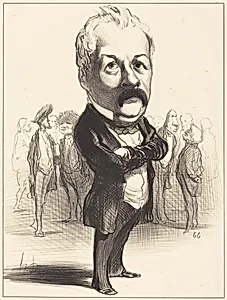
Medium
lithograph
Classification
Department
CG-E
Museum
National Gallery of Art, Washington, D.C.
Credit
Rosenwald Collection
Accession Number
1958.8.31
Rights
Public Domain
Art Historical Context
In the National Gallery of Art’s Rosenwald Collection, Honoré Daumier’s 1849 lithograph “Gustave Sautayra” offers a compelling example of the artist’s renowned skill in printmaking. Daumier, a leading figure in 19th-century French art, used lithography to produce incisive portraits and social commentaries that reached broad audiences through periodicals and affordable prints. This work exemplifies his ability to convey personality and character through economical yet expressive lines. Lithography, a relatively new medium at the time, allowed artists like Daumier to create detailed images that could be reproduced quickly and in large numbers. The technique’s tonal range and fluid drawing style suited Daumier’s direct, observational approach, making his prints both artistically powerful and widely accessible. As part of the museum’s holdings in prints, this piece highlights how such works bridged fine art and popular culture. Dating to 1849, the lithograph emerged during a period of political transition in France following the 1848 revolution. Daumier’s prints from this era often captured the individuals shaping public life, inviting viewers to consider the human stories behind historical events.
About the Artist
Honoré Daumier · 1810–1879
Honoré-Victorin Daumier (1808-1879) was a prolific French printmaker, caricaturist, painter, and sculptor whose works offered incisive commentary on the social and political life of 19th-century France. Known as the 'Michelangelo of Caricature,' Daumier produced over 4,000 lithographs, 500 paintings, 1,000 drawings, and 100 sculptures during his lifetime. His biting political satire led to his imp...