
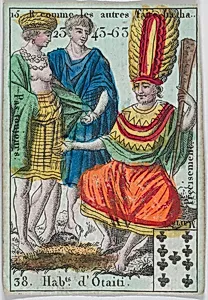
Hab.ts d'Otaiti from playing cards "Jeu d'Or"
Medium
Etching and hand coloring (watercolor)
Dimensions
3 3/16 × 2 1/16 in. (8.1 × 5.3 cm)
Classification
Prints|Ornament & Architecture
Department
Drawings and Prints
Museum
Metropolitan Museum of Art, New York, NY
Credit
Gift of the Estate of James Hazen Hyde, 1959
Accession Number
59.654.14(30)
Rights
Public Domain
Tags
Art Historical Context
Step into the whimsical world of 18th-century French playing cards with *Hab.ts d'Otaiti* from the *Jeu d'Or* deck, a delightful etching hand-colored with watercolor by an anonymous artist. Measuring just 3 3/16 × 2 1/16 inches, this petite print captures inhabitants of Otaheite— the European name for Tahiti—depicting men and female nudes in an exoticized style that reflects the era's fascination with distant Pacific cultures. Likely inspired by early accounts of voyages to the South Seas, it blends ornamentation with a touch of fantasy, classified under Prints, Ornament & Architecture. Crafted between 1700 and 1799, the technique of etching allowed for precise lines, while the delicate hand-applied watercolor brought vibrant life to these miniature scenes, making each card a tiny work of art. Playing cards like these were not just for games but served as affordable, portable decorations showcasing global curiosities amid Europe's Age of Exploration. Today, housed in the Metropolitan Museum of Art's Drawings and Prints department (gift of the Estate of James Hazen Hyde, 1959), this card offers a glimpse into how 18th-century French society romanticized "noble savages," blending entertainment with cultural commentary in an intimate format perfect for parlors and pockets.
About the Artist
Anonymous, French, 18th century · 1700–1800
The artist known as Anonymous, French, 18th century, represents a collective of unidentified talents active roughly between 1700 and 1800, a period of profound artistic evolution in France from the opulent Rococo to the austere dawn of Neoclassicism and Revolutionary fervor. Little is documented about their personal training or mentors, as their anonymity obscures individual biographies, though th...