
Haddock
1886
Medium
Painting
Classification
Painting
Department
Smithsonian Collection
Museum
Smithsonian American Art Museum
Credit
Smithsonian American Art Museum, Bequest of Allyn Cox
Accession Number
1983.31.20
Rights
Public Domain
Tags
About this artwork
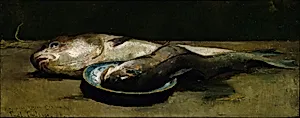
These slippery haddock are fresh from the sea and ready for cooking. Emil Carlsen's painting is one in a series of still lifes showing game, fish, and household utensils. The artist was inspired by the eighteenth-century French painter Jean Simeon Chardin, whose paintings he saw during a six-month stay in Paris in the late 1870s. Carlsen exhibited his still-life scenes in Boston, where they earned him critical and commercial success. This painting was a gift to his friend the artist Kenyon Cox, ...
Art Historical Context
Emil Carlsen'sHaddock* (1886) captures the glistening freshness of fish straight from the sea, poised on a dish and ready for the kitchen. This oil painting belongs to a series of still lifes featuring game, fish, and everyday utensils, showcasing Carlsen's mastery in rendering textures—from the slick scales of the haddock to subtle reflections of light. As a Danish-American artist active in the late 19th century, Carlsen inspiration from the 18th-century French master-Siméon Chardin, whose still lifes he encountered during a six-month stay in Paris in the late 1870s. The painting reflects Carlsen's commitment to quiet realism, evoking a sense of everyday abundance and tactile appeal. Exhibited in Boston, his still lifes garnered critical acclaim and commercial success, establishing him as a leading figure in American still-life painting. *Haddock* holds added personal significance as a gift from Carlsen to his friend, the artist Kenyon Cox—whose own works grace the Smithsonian American Art Museum collection. Today, housed in the Smithsonian American Art Museum through the bequest of Allyn Cox, this piece invites viewers to appreciate the humble beauty in ordinary subjects, bridging European traditions with American artistry.