
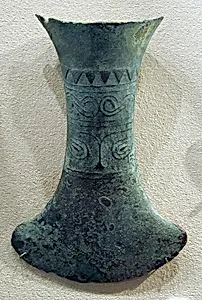
Hafted Flask-Shaped Ax with Face
Unknown Artist
ca. 500 BCE–300 CE
Medium
Bronze
Dimensions
H. 5 1/8 in. (13 cm); W. 3 3/8 in. (8.6 cm)
Classification
Metalwork
Culture & Period
Indonesia · Bronze and Iron Age period
Department
Asian Art
Museum
Metropolitan Museum of Art, New York, NY
Credit
Samuel Eilenberg Collection, Bequest of Samuel Eilenberg, 1998
Accession Number
2001.433.404
Rights
Public Domain
Art Historical Context
This striking bronze hafted flask-shaped ax with face, dating to approximately 500 BCE–300, hails from ancient Indonesia during the Bronze and Age. Measuring just 5⅛ inches high and 3⅜ inches wide, its compact form belies its dual role as both a practical tool—likely for chopping or warfare—and a work of art. The "hafted" design features a socket for attaching a wooden handle, while the bulbous, flask-like body tapers elegantly, showcasing advanced lost-wax casting techniques typical of Southeast Asian metalwork. The anthropomorphic face etched into the ax's surface adds a layer of intrigue, hinting at cultural beliefs in spirits or ancestors imbued in everyday objects. Such artifacts from Indonesia's Bronze Age reflect a sophisticated society skilled in bronze production, possibly linked to trade networks across island Southeast Asia. These axes were not merely utilitarian; their stylized forms suggest ceremonial or status symbolism. On view in the Metropolitan Museum of Art's Asian Art Department, this piece from the Samuel Eilenberg Collection invites us to ponder the ingenuity of unnamed artisans who blended function, form, and mysticism over 2,000 years ago.