
Hagar in the Desert
1551 to 1600
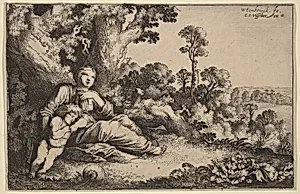
Medium
etching on laid paper
Dimensions
sheet (trimmed to plate mark): 10.5 x 16 cm (4 1/8 x 6 5/16 in.)
Classification
Department
CG-E
Museum
National Gallery of Art, Washington, D.C.
Credit
Ailsa Mellon Bruce Fund
Accession Number
1983.38.1
Rights
Public Domain
Art Historical Context
In the intimate etching *Hagar in the Desert created by Dutch engraver Moyses vanyttenbroeck between1551 and 1600, we encounter a poignant biblical scene from Genesis. Hagar, the Egyptian servant cast out into the wilderness with her son Ishmael by Abraham Sarah, embodies themes of exile, divine providence, and maternal despair. Van Uyttenbroeck, in the vibrant printmaking scene of the Northern Netherlands during the late Renaissance, captures this moment with delicate precision, likely drawing from earlier compositions by artists like Jan Gossart or Maarten van Heemskerck. Etching on laid paper—a technique where acid etches fine lines into a metal plate—allowed van Uyttenbroeck to produce intricate details in this compact 10.5 x 16 cm sheet, trimmed to the plate mark. This medium revolutionized printmaking in the 16th century, enabling affordable dissemination of religious narratives to a wide audience amid the Reformation's religious fervor. The visible laid lines of the paper add tactile authenticity, evoking the era's craftsmanship. Acquired through the Ailsa Mellon Bruce Fund and housed in the National Gallery of Art's Prints department (CG-E), this work highlights the era's fusion of spirituality and artistry. It invites visitors to reflect on enduring human stories rendered in miniature scale, a testament to print's role in democratizing art.