
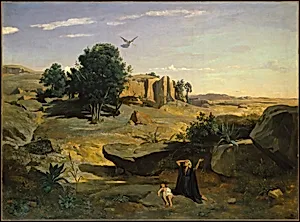
Hagar in the Wilderness
1835
Medium
Oil on canvas
Dimensions
71 x 106 1/2 in. (180.3 x 270.5 cm)
Classification
Paintings
Department
European Paintings
Museum
Metropolitan Museum of Art, New York, NY
Credit
Rogers Fund, 1938
Accession Number
38.64
Rights
Public Domain
Tags
Art Historical Context
Camille Corot's *Hagar in the Wilderness* (1835) is a monumental oil on canvas that captures a poignant biblical scene from Genesis. Depicting the Egyptian servant Hagar and her son Ishmael, cast out into the desolate wilderness by Abraham and Sarah, the painting evokes themes of exile, despair, and divine intervention. The angel's promise of water in the distance offers a glimmer of hope amid the vast, arid landscape, blending human drama with nature's sublime power. Painted during Corot's formative years traveling in Italy, this work exemplifies his early mastery of the Barbizon style, bridging Romanticism and emerging Realism. Corot's loose brushwork and subtle tonal gradations create an atmospheric haze, softening the rugged terrain and infusing the scene with poetic melancholy. At over seven feet wide, its grand scale immerses viewers in the emotional expanse, a hallmark of 19th-century French landscape painting that elevated nature as a narrative force. Acquired by The Metropolitan Museum of Art through the Rogers Fund in 1938, this masterpiece highlights Corot's influence on later Impressionists like Monet. Its tags—Children, Women, Landscapes—underscore its tender focus on vulnerability within epic scenery, inviting reflection on faith, motherhood, and the human spirit's resilience.
About the Artist
Camille Corot · 1796–1875
Jean-Baptiste-Camille Corot, born in Paris on July 16, 1796, into a prosperous bourgeois family—his father a former wig maker turned draper, his mother a successful milliner—initially resisted his artistic calling. After a lackluster education at the Lycée Pierre-Corneille in Rouen and failed apprenticeships in business, he abandoned commerce at age 26, thanks to a generous parental allowance foll...