
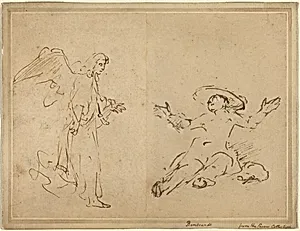
Hagar Seated at the Fountain
1654/1655
Medium
pen and brown ink
Dimensions
Overall (Right Sh): 13.6 x 9.3 cm (5 3/8 x 3 11/16 in.) overall (joined Sh): 13.6 x 18.2 cm (5 3/8 x 7 3/16 in.) overall: 86.3 cm (34 in.)
Classification
Drawing
Department
CG-E
Museum
National Gallery of Art, Washington, D.C.
Credit
Widener Collection
Accession Number
1942.9.662
Rights
Public Domain
Art Historical Context
In the mid-1650s, van Rijn, the preeminent Dutch Baroque master, captured a poignant biblical moment in *Hagar Seated at Fountain*. This pen and brown ink drawing depicts Hagar, the Egyptian servant from the Book of Genesis, resting wearily by a water source in the desert. Exiled with her son Ishmael, she discovers the fountain through divine intervention, a scene symbolizing despair turning to hope. Rembrandt's choice of this Old Testament narrative reflects his lifelong fascination with human emotion and spirituality, themes central to his oeuvre during a turbulent period marked by personal financial struggles. Rembrandt's genius shines in the drawing's economical yet expressive technique. Using fluid brown ink lines, he masterfully employs hatching and cross-hatching to model form, evoke texture, and suggest deep psychological introspection. The modest scale—joined sheets measuring about 13.6 x 18.2 cm—belies its monumental emotional impact, showcasing his ability to convey volume and light with minimal means. Such drawings were often preparatory studies or independent works, prized for their spontaneity in the Dutch Golden Age tradition. Housed in the National Gallery of Art's Widener Collection, this 1654/55 gem exemplifies Rembrandt's enduring influence on drawing as a fine art. Visitors are drawn to its intimate humanity, inviting reflection on resilience amid adversity—a timeless resonance from the 17th century to today.
About the Artist
Rembrandt van Rijn · 1606–1669
Rembrandt Harmenszoon van Rijn (1606–1669) stands as one of the greatest visual artists in the history of Western art and the most important Dutch painter of the 17th century. Born in Leiden to a prosperous miller's family, Rembrandt transformed painting through his revolutionary use of light and shadow, his psychological depth in portraiture, and his elevation of etching to a fine art. His approx...