
Hairpin
Unknown Artist
200–500
Medium
Copper alloy
Dimensions
Overall: 2 11/16 x 1/4 in. (6.8 x 0.6 cm)
Classification
Metalwork-Copper alloy
Culture
Roman
Department
Medieval Art
Museum
Metropolitan Museum of Art, New York, NY
Credit
Gift of J. Pierpont Morgan, 1917
Accession Number
17.191.66
Rights
Public Domain
Art Historical Context
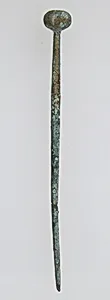
This delicate copper alloy hairpin, crafted by an unknown Roman artisan between 200 and 500 CE, offers a glimpse into the everyday elegance of Late Roman life. Measuring just 2 11/16 x 1/4 inches (6.8 x 0.6 cm), it was used by women to secure elaborate hairstyles, blending functionality with subtle adornment. During this transitional period from the Roman Empire to early medieval times, such personal accessories were common among the middle and upper classes, reflecting a culture valued grooming and status even in intimate objects. Copper alloy, an accessible yet durable medium, was widely used for metalwork like this due to its workability—easily cast, hammered, or engraved for decorative details. Though simple in form, hairpins like this one highlight the technical skill of Roman craftsmen, who produced thousands for domestic use across the empire. Its presence in the Metropolitan Museum of Art's Medieval Art department underscores its role in bridging classical antiquity and the medieval world. A generous gift from financier J. Pierpont Morgan in 1917, this artifact reminds us that history lives in the smallest treasures, revealing the refined tastes of Romans over 1,500 years ago.