
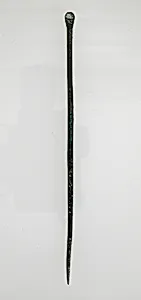
Hairpin
Unknown Artist
7th century
Medium
Bronze
Dimensions
Overall: 4 15/16 x 3/16 x 1/16 in. (12.6 x 0.4 x 0.2 cm)
Classification
Metalwork-Bronze
Culture
Frankish
Department
Medieval Art
Museum
Metropolitan Museum of Art, New York, NY
Credit
Gift of J. Pierpont Morgan, 1917
Accession Number
17.193.42
Rights
Public Domain
Art Historical Context
This delicate bronze hairpin, crafted by an unknown Frankish artisan in the 7th, offers a glimpse into the everyday elegance of early medieval Europe. Measuring just under 5 inches long and remarkably slender at 3/16 by 1/16 inches, it was likely used by women to secure elaborate hairstyles, a common practice among the Franks—a Germanic people who dominated much of what is now France and Germany during the Merovingian dynasty Now housed in the Metropolitan Museum of Art's Medieval Art department it entered the collection as a gift from J Pierpont Morgan in 1917. Frankish metalwork like this hairpin exemplifies the continuity of Roman-era techniques into the post-Roman world, where bronze was cast or hammered into functional yet refined forms. Such personal adornments were not mere utilities; they reflected social status and cultural identity, often appearing in Merovingian burials as cherished grave goods. The simplicity of its design—sleek and unadorned—highlights the practical artistry of a time when grand Roman workshops had faded, giving way to localized craftsmanship that blended utility with subtle beauty. Today, this unassuming object bridges us to the lives of Frankish women, reminding us how small artifacts illuminate the textures of history—from daily grooming rituals to the enduring skill of early medieval smiths.