
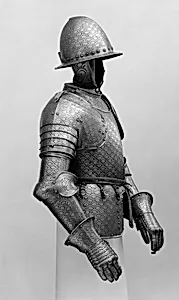
Half Armor
Unknown Artist
ca. 1600; cheekplates of helmet and part of left gauntlet thumb, probably 19th century
Medium
Steel, brass
Dimensions
Wt. approx. 25 lb. 14 oz. (11.74 kg); Wt. of helmet 3 lb. 5 oz. (1502.5 g)
Classification
Armor for Man-1/2 Armor
Culture
Italian
Department
Arms and Armor
Museum
Metropolitan Museum of Art, New York, NY
Credit
Rogers Fund, 1916
Accession Number
16.154.3a–l
Rights
Public Domain
Art Historical Context
This exquisite Half Armor, crafted in Italy around 1600, exemplifies the pinnacle of Renaissance armor-making during a time when plate armor was evolving amid the rise of firearms. Produced in steel with brass accents, it protected the upper body—torso, arms, and head—making it ideal for cavalry or lighter combat roles, when full suits had become cumbersome. Italian workshops, renowned across Europe for their precision, created such pieces for nobility and mercenaries, blending functionality with elegant form. The helmet weighs just over 3 pounds, while the full ensemble tips the scales at nearly 26 pounds, a testament to skilled metallurgy that balanced protection and mobility. Note the cheekplates on helmet and part of the left gauntlet thumb, likely 19th-century restorations to preserve its integrity. Acquired through the Rogers Fund in 1916, this armor now graces the Metropolitan Museum of Art's Arms and Armor collection, offering a tangible link to the Age of Exploration and the Italian Wars. Its cultural significance lies in Italy's legacy as Europe's armor capital, where techniques like hammering and polishing steel produced both battlefield gear and parade pieces symbolizing status and chivalry. Visitors, imagine donning it for a duel—its weight a reminder of the warrior's endurance.