
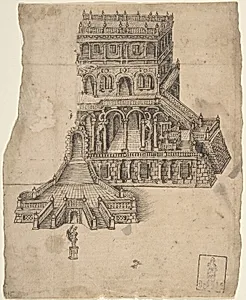
Half design for a palace - fortress with a statue in front
16th century
Dimensions
sheet: 7 1/2 x 5 13/16 in. (19 x 14.7 cm)
Classification
Drawings|Ornament & Architecture
Department
Drawings and Prints
Museum
Metropolitan Museum of Art, New York, NY
Credit
The Elisha Whittelsey Collection, The Elisha Whittelsey Fund, 1968
Accession Number
68.664.5
Rights
Public Domain
Tags
Art Historical Context
This delicate 16th-century drawing created by an anonymous German artist, presents a "half design" for a grand palace-fortress, crowned by a towering statue in front. Rendered on a modest sheet measuring just 7½ x 5⅞ inches, it captures the Renaissance-era fascination with monumental architecture that merged defensive strength—evident in the robust walls and battlements—with palatial splendor. The inclusion of sculpture, highlighted in the work's tags, underscores the's emphasis on integrating figurative art into built environments, evoking imperial power and cultural prestige. In 16th-century Germany, amid the Holy Roman Empire's political turbulence and the spread of Italian Renaissance ideas northward, such designs reflected architects' and patrons' dreams of fortified residences symbolizing both security and sophistication. Classified under Drawings, Ornament & Architecture at The Metropolitan Museum of Art, this piece likely served as a preparatory study, showcasing precise line work typical of the period's draftsmen who used pen and ink (or similar media) to explore proportions and decorative motifs. Today, housed in The Elisha Whittelsey Collection, this anonymous gem offers a window into the creative processes behind Europe's evolving urban landscapes, reminding us how sketches like this fueled the construction of enduring landmarks blending fortification, sculpture, and opulence.